
If you manage affordable housing properties, May 1 is not just another date on the calendar. It is when updated 2026 income rent limits are released, and those numbers affect how you qualify residents and set rents for the coming year.
Understanding and applying 2026 income rent limits the right way helps you stay compliant and ready for file reviews. These limits shape resident eligibility, rent calculations, and the records auditors expect to see.
Properties that get these numbers wrong can face findings during reviews, repayment issues, and operational headaches. Here is what property managers need to know now.
Table Of Contents:
- Why the 45-Day Rule Matters for 2026 Income Rent Limits
- Where to Find the Official Numbers
- Six Critical Factors You Must Verify
- Understanding Area Median Income Changes
- How 2026 Income Rent Limits Affect Resident Qualifications
- Rent Calculations and Maximum Allowable Rents
- Common Mistakes Properties Make with New Limits
- Documentation Requirements for Compliance
- State Agency Variations and Requirements
- Planning for Annual Limit Updates
- Getting Expert Help with Complex Situations
- Conclusion
Why the 45-Day Rule Matters for 2026 Income Rent Limits
When new limits are released, you have 45 days to put them into use. This is a required compliance deadline, not a best practice you can push back.
Since the 2026 income rent limits were released on May 1, the implementation deadline falls on June 15, 2026. That gives management teams a short window to review the limits memo, update software, revise forms, and train staff.
This deadline affects properties operating under programs such as low-income housing tax credit rules, housing assistance programs, and other regulated affordable housing requirements. Missing it can create problems during your next monitoring visit or audit.
The timing matters because your team may still be finishing spring recertifications or lease-up activity. If you do not switch to the correct limits on time, files created after the deadline may be out of compliance.
A rushed update can be just as risky as a late one. It is better to assign responsibilities early, review the main content of the new release, and confirm every number before your team starts using it.
Where to Find the Official Numbers
You should pull limits from the right source every time. Using numbers copied from a secondary spreadsheet or an unofficial website belongs on your do-not-use list.
For properties under the low-income housing tax credit (LIHTC) program, the standard source is the Multifamily Tax Subsidy Project (MTSP) Income Limits data published through Policy Development and Research. Many compliance teams also monitor the HUD exchange for related policy guidance, featured publications, and updates log notices.
For HOME units, use the HOME Income Limits and HOME Rent Limits issued for that program. The calculation methods differ from tax credit properties, so the same chart does not work for both.
State agencies may also post companion files, basic policy notes, or a limits memo on an official website. Some managers use a resource library, frequently asked questions collections, or recorded webinars from the agency to confirm local housing assistance rules.
If your agency offers email updates, sign up for them. Those notices can help you catch revisions, technical assistance announcements, or upcoming training after the first release.
If you need broader reference material, many agencies organize support by learning pathways, online trainings, self-paced online trainings, and guided learning opportunities. Those tools are useful for newer staff members who need a repeatable process each year.
For a streamlined way to check specific area data, many professionals utilize the Novogradac Income & Rent Calculator to verify figures across different counties and programs.
Six Critical Factors You Must Verify
Looking up your county is only the first step. You also need to confirm several property details before applying any income or rent figures.
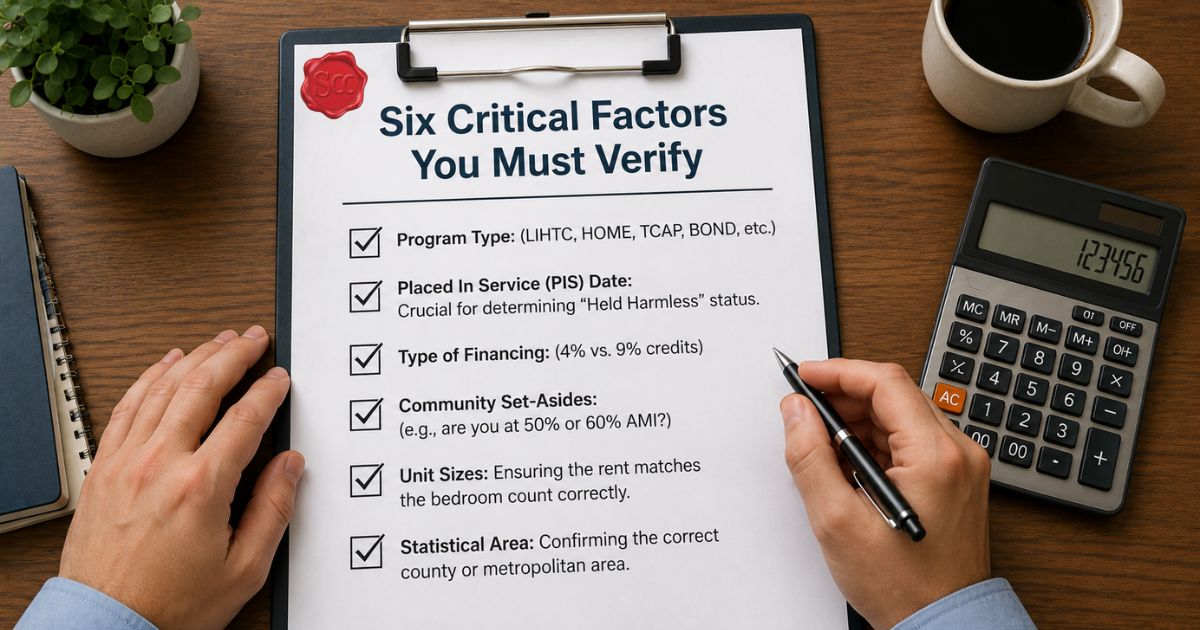
Use this checklist before you approve a certification or update a rent schedule:
- Program type, such as tax credit, HOME, bond, or another housing trust fund source.
- Placed in service date for held harmless review and legacy rule checks.
- Funding source details, including housing trust, trust fund, or emergency solutions grants rules if they apply.
- Set-aside election, such as 20/50, 40/60 or the new AIT (Average Income Test).
- Correct bedroom size and occupancy assumption for each unit.
- Metropolitan or non-metropolitan area classification.
These details affect the limits you use and the rents you charge. One wrong item can lead to the wrong income limit, the wrong rent limit, or both.
For example, a property with tax credits and local housing assistance may need to compare multiple limits and apply the most restrictive one. Another site may have a housing trust overlay that creates more restrictive fund income rules than the federal chart alone.
If your property has layered financing, your compliance file should clearly explain how you selected the controlling numbers. This helps staff stay consistent and gives auditors a clear record.
Understanding Area Median Income Changes
Area Median Income (AMI) changes each year based on federal census and inflationary data. For 2026, while many areas are seeing increases, some regions are staying flat.
AMI Red Flags to Watch For:
- Unexpected Decreases: If the AMI for your county dropped, check your “Placed in Service” date immediately. You may be “Held Harmless,” but newer properties may have to lower their rent caps.
- Boundary Reclassifications: HUD occasionally shifts counties in or out of Metropolitan Statistical Areas (MSAs). A building hasn’t moved, but its “Area” definition might have, changing your limits overnight.
- Software Lag: Never assume your property management software updated correctly. Cross-reference the system’s 2026 numbers against the MTSP/LIHTC Data manually before certifying a new file.
How 2026 Income Rent Limits Affect Resident Qualifications
Income limits decide who is eligible for restricted units. Each applicant household must fall at or below the proper threshold for household size and program rules.
When 2026 income rent limits rise, more households may qualify on paper. That can help with lease-up, waiting list movement, and occupancy planning.
Still, eligibility does not stop at the chart. You must verify income, assets, and household composition under the applicable program rules and keep the full backup in the tenant file.
For annual recertifications, staff must use the correct current-year limits once your property implements them. If your software or paper forms still show prior-year numbers after the deadline, your certifications may be at risk.
Existing residents are handled differently from new move-ins in many programs. Over-income treatment depends on the rule set tied to the property, whether that is public housing, tax credits, or another housing assistance structure.
It also helps to train leasing and compliance staff together. Leasing teams often speak first with applicants, so they need the same information as the people completing the file review.
Rent Calculations and Maximum Allowable Rents
After you confirm the correct income limits, you can move to rent calculations. For many regulated units, the rent limit is based on 30% of the applicable income standard adjusted by household size assumptions.
Bedroom size matters here. Unlike income limits—which are based on how many people actually live in the unit—rent limits are based on a standard formula regardless of the family size. Think of it this way: For a two-bedroom unit, HUD assumes a “household” of 3 people (1.5 people per bedroom). Even if a single mom and her child live there, or a family of four, the maximum rent you can charge stays the same because it is tied to the unit size, not the people. This ensures your property’s revenue remains stable, but it also means you must use the correct 3-person income limit to calculate that rent cap.
You also need to subtract the correct utility allowance from the maximum gross rent to find the tenant-paid rent. If you skip this step or use an old utility chart, your rent schedule may be too high.
Many agencies publish fair market rents and fair market data at the same time or in nearby guidance. While fair market rents do not replace your program-specific calculation, they may still affect voucher activity, underwriting discussions, or local comparisons.
Some sites have added restrictions from state agencies, local housing programs, or a housing trust fund agreement. In those cases, you use the most restrictive rent limit that applies.
Document each step in a way another staff member can follow. A simple worksheet can save hours later if an auditor asks how the number was produced.
Common Mistakes Properties Make with New Limits
Even the most seasoned management teams can run into trouble during the annual transition. Most errors in affordable housing compliance aren’t caused by a lack of effort, but by subtle technical misunderstandings or reliance on outdated local data. To ensure your next file review is successful, keep a close watch on these high-risk areas.
Expert Insight: The “No Tax on Overtime” Trap
Many Texas managers are currently falling into a dangerous compliance trap regarding the One Big Beautiful Bill Act (OBBBA). While this legislation has changed how certain local taxes are handled for employees, it is critical to remember that HUD income inclusion rules have not changed. It is a high-risk mistake to assume that ‘non-taxable’ is the same as ‘non-countable’ for eligibility purposes; doing so is a major red flag that leads to immediate audit findings. Always cross-reference your internal payroll data against specific HUD guidelines rather than relying on local tax-exempt status.

Beyond specific legislative traps, a frequent mistake is assuming that every area receives an automatic limit increase every year. This is not always the case; depending on federal census data and inflationary adjustments, some regions may stay flat or even decrease. Relying on market rent trends in nearby conventional properties is a mistake, as these do not control or correlate with 2026 LIHTC income calculation standards.
Finally, recordkeeping errors continue to be a leading cause of non-compliance. If your files cannot clearly demonstrate exactly when the 2026 limits were implemented in your system, reviewers may question whether you met the mandatory 45-day rule. Properties often overlook the importance of saving the official limits memo and training logs as proof that the transition occurred before the June 15 deadline.
Other High-Risk Areas to Monitor:
- Software Defaults: Never assume your property management software updated correctly. Staff often keep using old figures because no one manually verified the system defaults against the MTSP/LIHTC Data.
- Mixing Program Charts: A common technical error is using a tax credit rent chart for a HOME unit. Each program has specific federal requirements; a local housing restriction should never be ignored just because the federal limit is higher.
- Ignoring Layered Funding: If you have mixed programs or older compliance documents, the rules for “Held Harmless” properties may conflict with newer funding sources.
- Waiting Too Late for Expert Help: Many teams wait until a file review results in a finding before seeking guidance. Requesting in-depth assistance for file sampling or implementation plans before the deadline is a much more cost-effective strategy.
Documentation Requirements for Compliance
Auditors want to see that you used the correct 2026 income rent limits and started using them on time. Your files should make that easy to prove.
Keep copies of the official limits, related spreadsheets, and any state-issued guidance. Save them in a shared folder and a permanent compliance archive with clear file names.
Also keep proof of internal action steps, including software updates, revised rent schedules, and staff training logs. If your agency offers on-demand training, recorded webinars, or self-paced online materials, save completion records for staff members who attended.
Your tenant files should show which limits were used for each certification or recertification. Include the effective date and enough backup so another reviewer can trace the decision.
If your team uses checklists, this is a good time to update them. Add fields for program type, bedroom count, county, utility allowance, and the exact chart used.
For larger companies, it also helps to identify who owns each part of the process. An internal organizational chart can show whether compliance, operations, or regional management handles approvals and final sign-off.
State Agency Variations and Requirements
Federal numbers are only part of the picture. State agencies often add forms, notices, or implementation rules that property managers must follow.
Your agency may post updates on its government website or other official websites, often in sections like browse regulations, frequently asked questions, or explore collections. Some agencies also publish featured publications that summarize annual changes.
These state materials can cover rent rounding methods, notice timing, utility allowance treatment, and file retention expectations. They may also address local housing or community project requirements that affect specific developments.
If your property receives state funds, local subsidies, or housing counseling support tied to another program, compare every source before finalizing your chart. The most restrictive rule usually controls.
It is smart to assign one team member to monitor agency notices, email updates log items, and faq collections throughout the release period. That keeps late corrections from slipping through the cracks.
Planning for Annual Limit Updates
Good compliance work starts before May 1. The smoothest properties treat annual limits as a planned project rather than a last-minute scramble.
Start preparing in late February, as the release of the limits varies from year to year. Generally, it occurs for MTSP on April 1st and then the HOME Limits are released shortly after. This year was unique because the MTSP limits were delayed and aligned with the HOME Limits being released in May. Include downloading files, checking state notices, reviewing software setup, and assigning final approval responsibility.
Schedule training every year for leasing, compliance, and site managers. Agencies often offer learning opportunities, guided learning, online trainings, and upcoming training sessions that can help refresh the rules.
You can also keep a small internal reference set with your current checklists, resident notice templates, and archived charts. A resource library like this helps new hires avoid repeated mistakes. Check here for our Audit-Ready Method.
If your company has more complex properties, consider setting aside time each year for request in-depth review meetings. This is especially useful for sites with multiple programs, unusual financing, or shifting area designations.
Some companies even maintain a form title search or title search log for regulatory agreements so staff can quickly locate documents tied to rent limits. A form title search may sound simple, but it can speed up answers when several agreements control the same building.
Getting Expert Help with Complex Situations
Some properties are harder to sort out than others. Mixed-finance sites, layered funding, older regulatory agreements, and overlapping set-asides can create real confusion.
That is where outside review can help. A specialist can compare funding documents, agency guidance, and property history to confirm which limits apply.
At Sanchez Compliance and Consulting, we help property managers review the rules tied to their sites and apply 2026 income rent limits correctly. That includes support for tax credit properties, developments with housing trust restrictions, and projects with local housing assistance overlays.
We can also review documentation practices, staff workflow, and current rent schedules before an agency visit. If needed, property teams can request in-depth assistance for file sampling, implementation plans, and audit preparation.
That kind of review helps prevent small errors from becoming larger findings later. It also gives your team a cleaner process to follow year after year.
Conclusion
The release of 2026 income rent limits sets off a short compliance timeline for affordable housing operators. From resident qualifications to rent schedules, these numbers affect daily operations almost immediately.
To apply them correctly, you need more than a quick chart lookup. You need the right source, the right program rules, the right property details, and documentation that clearly shows what your team did and when.
If you build a repeatable process, monitor agency guidance, and verify every limit before use, your property will be in a much stronger position during audits and management reviews. When questions come up, Sanchez Compliance and Consulting can help tie the pieces together so your site stays accurate, compliant, and ready for the year ahead.
Ready for your 2026 Implementation?
From “No Tax on Overtime” traps to layered funding calculations, we help you get the numbers right the first time. Secure your property’s compliance status today with a comprehensive review from Sanchez Compliance & Consulting. Get Started ->